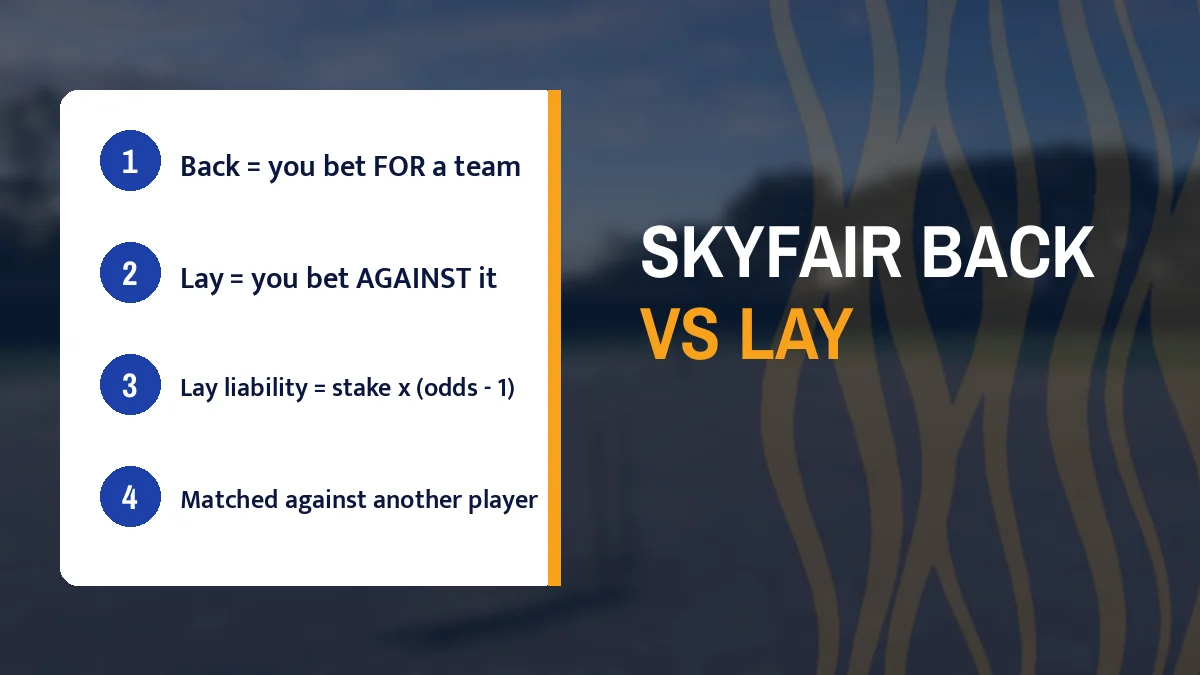
Backing on SkyFair = for
You say an outcome will happen. Team A wins, a player reaches a score, a set goes one way. Your risk is the stake you typed.
Back, lay, liability
On the SkyFair exchange you take a price from another player, not from a house: back a team to win, or lay it to lose and stand in as the bookmaker yourself. One cricket match below carries both sides in rupees, then the taps for a first matched bet.

In-play entry
+91 81097 11726 · SkyFair Exchange Order Pad

Every bet on the SkyFair exchange has two people behind it. One backs. The other lays. SkyFair sits between them, holds what each side could lose, and pays out once the official result settles the market, which is the rule printed in the lobby itself.
You say an outcome will happen. Team A wins, a player reaches a score, a set goes one way. Your risk is the stake you typed.
Team A loses, you collect. If Team A wins instead, you owe the person who backed it their profit, a figure SkyFair labels liability and holds back until settlement.
Two players, one price. A back offer at 2.10 only turns into a live bet when someone else on SkyFair is willing to lay 2.10 for that amount, and the rules add a timing catch: anything matched after the scheduled start of an event is void, so a price that gets taken too late simply does not count.
Take an imaginary T20, Team A against Team B. The numbers here are made up for the arithmetic; real SkyFair prices move ball to ball during play.
Say Team A shows a back price of 2.10. You put ₹500 on it.
| Result of the match | What happens to your ₹500 back on SkyFair |
|---|---|
| Team A wins | Return ₹1,050 (500 × 2.10). Profit ₹550. |
| Team B wins | The ₹500 stake goes to the player who laid you. |
Decimal odds include your stake. That is the one rule to keep in your head, because 2.10 does not mean you win ₹2.10 per rupee on top; it means the whole return is stake times price, so profit is always the price minus one, multiplied by the stake. At 1.50 a ₹100 back returns ₹150, a profit of ₹50. At 4.00 the same ₹100 returns ₹400.
Lower price, likelier result, smaller profit. Roughly that simple.
Inside SkyFair the price you tap can change before you confirm (the settings sheet has a switch called Highlight when odds change, which is there for exactly this). If the number flickers, read it again before pressing confirm, since the slip will carry whatever price is current.
Same match, other chair. Now you think Team A will lose, so you lay Team A on SkyFair at 2.12 for a backer's stake of ₹500.
Price minus one: 2.12 − 1 = 1.12.
Times the backer's stake: 1.12 × ₹500 = ₹560. That ₹560 is your liability.
Team A loses: you keep the backer's ₹500.
Team A wins: you pay the backer ₹560.
So a lay at 2.12 risks ₹560 to win ₹500. SkyFair has to see that ₹560 free in your balance before the lay goes through, not ₹500, and this is where most first-time layers get confused.
Liability grows fast at long prices. Lay ₹500 at 6.00 on SkyFair and the arithmetic is 5 × ₹500, which means ₹2,500 sits on the line to collect ₹500, and in practice that is why layers tend to stay near short prices where the downside is easier to carry. Short prices, small liability. Long prices, big liability.
Put another way: a back risks what you type, a lay risks what the backer could win.
Picture the only SkyFair row with two prices per team, one to be for and one to be against. Whoever fills your number is another account holder, so a 2.10 back pairs off with a 2.10 lay from somebody else.
Most of them typed the dot-com ending and expected the trading screen. On 17 Oct 2026 only the www form of that address loaded a SkyFair lobby; the exchange inside is the one this page explains.
Multiply stake by price for the full return. ₹500 at 2.10 returns ₹1,050, so the profit is ₹550 and the most you can lose is the ₹500 you typed.
Subtract one from the price and multiply by the backer's stake. Laying ₹500 at 2.12 holds ₹560 until the result settles, and that full figure must be free before the lay is accepted.
Open a cricket match on SkyFair and three kinds of market sit on the same screen. The rules list them by name: exchange back and lay, bookmaker, and fancy. They feel siilar for about ten seconds.
| SkyFair market | Who sets the price | What you are betting on |
|---|---|---|
| Exchange | Other players, through back and lay offers | Match outcome; you can be for or against |
| Bookmaker | The book side of the market | Match outcome at a quoted price |
| Fancy | The book side of the market | Something inside the match, such as runs in a session |
Why split them at all? Open the SkyFair settings list and you find one Accept Any Odds toggle for FancyBet, a second for SportsBook and an Accept Any Price toggle for Binary, so the fancy and bookmaker sides each get their own say on whether a price that moved between tap and confirm still goes through on your slip.
Against a favourite? On SkyFair you do not need to dig out a price for the underdog; a lay on the favourite does the job directly, using the liability sums from the section above. A bookmaker row mostly asks you to pick a side at its quoted number.
For the wider menu of SkyFair betting markets, sports and casino tiles, the SkyFair betting markets page covers what sits beyond cricket. It is probably the better first stop if you are not sure the exchange is what you want.
People who type skyfair com exchange are usually trying the dot-com ending first. Fair enough. On 17 Oct 2026, though, bare skyfair.com stayed silent for 15 seconds while www.skyfair.com answered and loaded a SkyFair lobby by script, so the www prefix was the difference between a blank tab and the markets; the full address list and its statuses live on the SkyFair home page.
Whichever official address answers that day, your username, password and balance carry over. Indian ISPs block betting addresses from time to time, which is why the ending changes and the account does not.
One small trap with the name. A Play Store calculator app is called Skyfair, and a Jalandhar travel agent trades as Skyfair Solutions; neither has anything to do with SkyFair exchange markets, back prices or lay liability.
You need an ID before any of this. The desk makes one in a WhatsApp chat, free, and the SkyFair ID page covers that part; deposits start at ₹100.
Sign in. The fields come in this order: Username, Password, then a Validation Code, which is a 4-digit number shown next to the box that you type in yourself.
Before your first bet, open the settings sheet and set a Default stake plus a few Quick Stakes with Edit Stakes. On a moving SkyFair market, one tap on a preset beats typing digits while the price shifts.
Find where the match lives. In-Play holds games already underway, Sports the rest; a cricket figure of 10 on the official card at 15:44 IST on 17 Oct 2026 was the number of SkyFair cricket books open right then, and it moves through the day.
Pick the match and find the exchange market. Tap a back price if you are for the team, a lay price if you are against it.
Check the slip: price, stake, and on a lay the liability. Confirm.
Following two or three games at once? Multi Markets on the bottom bar keeps them together.
That is the theory. In practice a few things trip people up. The rules void any bet matched after the scheduled off time, so a pre-match price you were slow to confirm may simply drop out, and SkyFair's rules also say that sign-ins from IPs that keep changing, or from several cities, can void bets or get the account suspended, which is worth sorting out before money is on the line rather than after.
Also void: bets you match against yourself across two accounts. SkyFair calls it punching, and such bets can be cancelled any time within a week of placement. One account per person, 18+ only.
The SkyFair bet slip page goes deeper on stakes and confirmation, if the slip itself is what you are stuck on.
It is the part of a SkyFair match screen where a second player fills your price instead of the house setting it. In the T20 example on this page, one person backs Team A with ₹500 at 2.10 and another lays it, risking ₹560 at 2.12, until the official result decides.
Back is a vote for a result and lay is a vote against it. Backing Team A with ₹500 at 2.10 can cost ₹500 at most. Laying the same ₹500 at 2.12 can cost ₹560, because on SkyFair the layer covers the backer's profit rather than a simple stake.
Yes, the search usually comes from people trying the dot-com address. On 17 Oct 2026 bare skyfair.com did not answer, while www.skyfair.com loaded a SkyFair lobby. The exchange markets, your username and your balance are the same on whichever official address works that day.
Take the lay price, subtract one, and multiply by the backer's stake. Laying ₹500 at 2.12 gives a liability of ₹560. SkyFair holds that amount from your balance until the market settles, and you pay it only if the outcome you laid actually happens.
The lobby rules text we read on 17 Oct 2026 does not state a commission figure for SkyFair exchange, so this page quotes none. Ask the 24/7 desk on WhatsApp at +91 81097 11726 before your first matched bet, and work out your expected profit only after you have its answer.
On the SkyFair exchange other players set the price and you can back or lay. On the bookmaker market the price is quoted by the book side and you mostly pick a team at that number. The settings sheet even keeps a separate Accept Any Odds switch for SportsBook.
The rules text does not print a per-bet minimum for SkyFair exchange markets. What the desk does state is a ₹100 minimum deposit and a ₹100 minimum withdrawal. Inside the lobby you can set a Default stake and Quick Stakes, so each slip opens on the amount you choose.